Leveraging AI for Smarter Business Connections at B2B Matchmaking Events
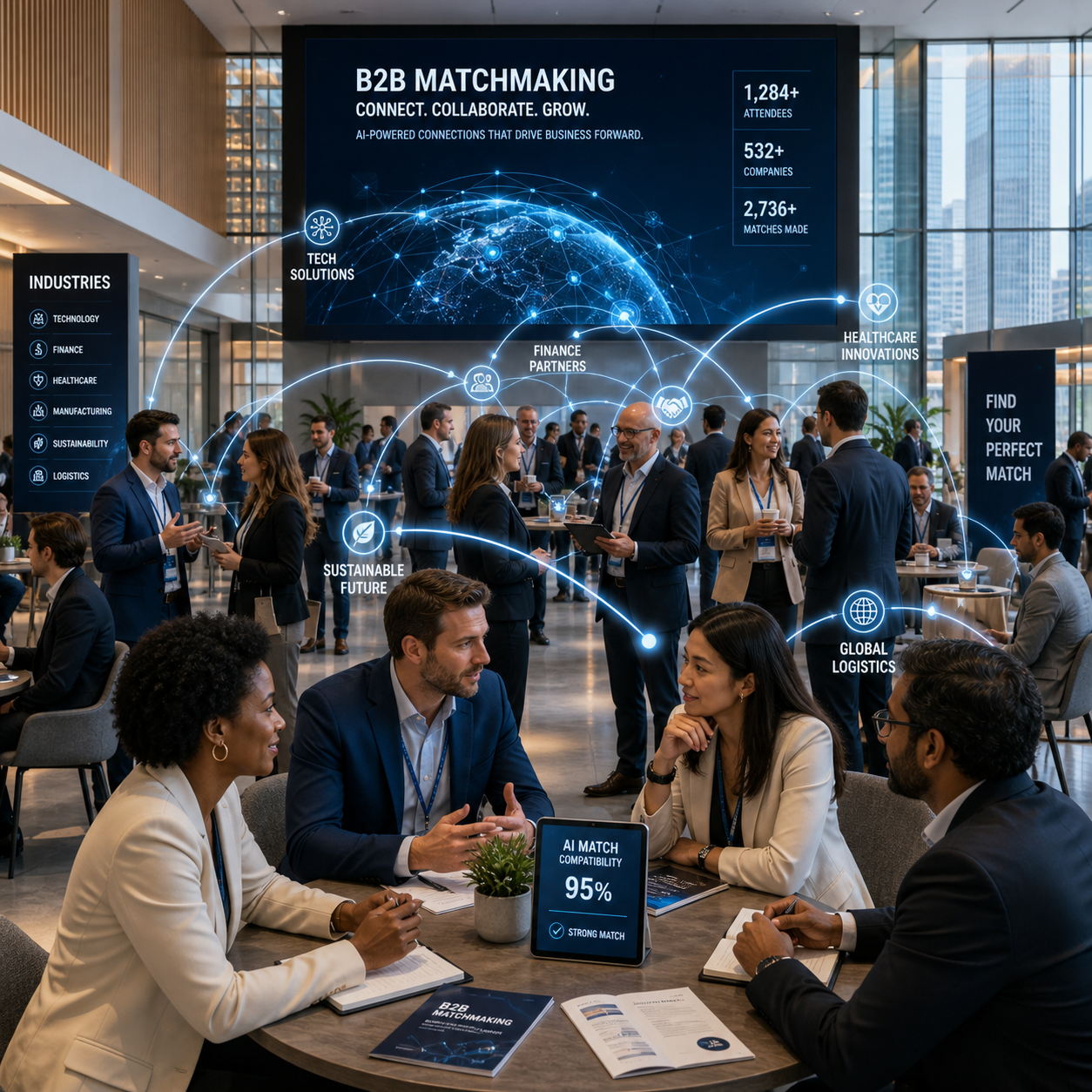
At a busy B2B event, the hardest part is rarely finding people. It is finding the right people before time runs out. Artificial intelligence can help event organizers, exhibitors, sponsors, and attendees turn scattered profiles and business goals into more relevant conversations.
AI does not create trust on its own. It improves the preparation, prioritization, and timing around human interaction so professionals spend less time on irrelevant introductions and more time exploring genuine opportunities.
Why AI Matters for B2B Business Connections
AI matters for B2B business connections because it can analyze large amounts of event information and make networking more relevant, efficient, and outcome-focused. At a conference with thousands of participants, manual browsing often leaves attendees relying on chance, familiar contacts, or the first profiles they notice.
An AI-supported event platform can compare attendee profiles, company information, industries, interests, purchasing needs, partnership goals, and preferred meeting formats. It can then surface potential customers, suppliers, investors, distributors, or strategic partners that match a participant’s objectives.
This changes the networking question from “Who is available?” to “Which connections are most useful for this business goal?” A software buyer may receive recommendations for implementation partners and technology vendors. An exhibitor entering a new market may discover local distributors or complementary service providers.
For event organizers, AI can improve the experience at scale. Better recommendations may increase meeting participation and help attendees use their time more intentionally. The limitation is equally clear: an algorithm can rank possibilities, but it cannot fully understand chemistry, timing, reputation, or the subtleties of a developing business relationship.
How AI Improves Attendee and Company Matching
AI improves attendee and company matching by comparing structured event data with each participant’s goals, capabilities, and interests. The quality of a matchmaking algorithm depends heavily on the information it receives, so accurate attendee profiles are the foundation of useful recommendations.
During registration, participants should be encouraged to provide specific details rather than broad statements. “Interested in technology” gives an algorithm little direction. “Seeking a logistics software provider for operations across three European warehouses” creates a much stronger matching signal.
What AI can evaluate
- Business objectives: buying, selling, sourcing, investing, hiring, distributing, or forming partnerships.
- Industry and market: sector, customer type, geography, company size, and target markets.
- Capabilities and needs: products offered, technical requirements, budgets, procurement timelines, and compliance expectations.
- Engagement behavior: profiles viewed, sessions selected, meeting requests, responses, and conversation topics.
- Practical availability: preferred meeting times, location, format, and language.
A useful system should show why a recommendation appears. For example: “Recommended because you are seeking a renewable-energy distributor in Germany and this company serves commercial installers.” Explainable recommendations help users decide whether to accept, decline, or investigate a suggested contact.
Organizers should also allow participants to correct their profiles and adjust priorities. Choosing broad categories may produce a high number of matches but lower relevance. More precise data takes a few extra minutes and generally gives the matchmaking process better direction.
Personalizing the Event Networking Experience
AI personalizes event networking by tailoring introductions, suggested conversations, meeting schedules, and content recommendations to each attendee’s objectives. This makes the event feel less like a crowded directory and more like a guided set of professional opportunities.
Before the event, an AI assistant can recommend a short list of contacts and draft an introduction based on shared business interests. The participant should review and edit that message. A natural note might mention a specific operational challenge, market overlap, or product application rather than sending a generic request to connect.
AI can also recommend conversation starters. If two companies are exploring supply-chain automation, the system might suggest discussing integration requirements, implementation timeframes, or relevant case studies. These prompts reduce the awkwardness of opening a conversation while leaving room for authentic dialogue.
Meeting recommendations can account for more than topical similarity. A platform may balance strategic value, availability, meeting duration, location, and the likelihood that both parties will accept. It can also suggest relevant workshops, roundtables, or exhibitor presentations based on the attendee’s stated needs.
Personalization has a boundary. Excessive automation can make every interaction sound identical, and inaccurate assumptions can create uncomfortable introductions. The strongest approach gives people useful context while preserving their choice over whom to meet and how to communicate.
Using AI to Strengthen Lead Generation and Follow-Up
AI strengthens lead generation by helping teams prioritize promising contacts, organize interaction data, and follow up while the conversation is still fresh. At the event, a sales or partnerships team may meet dozens of people, but not every contact deserves the same next step.
AI can help classify leads using information such as stated requirements, authority, purchase timeframe, company fit, meeting notes, and engagement level. A prospect who has an active project and requested a technical demonstration should receive different treatment from someone who only downloaded a brochure.
CRM integration makes this process more useful. With appropriate consent and configuration, meeting records, notes, contact details, event attendance, and follow-up tasks can move into a customer relationship management system. Teams can then assign owners, schedule reminders, and maintain a consistent record instead of relying on scattered spreadsheets or memory.
AI may also summarize meeting notes, identify agreed actions, and suggest a suitable follow-up sequence. A practical sequence could include a personalized email within 24 to 48 hours, a relevant resource, and a later check-in tied to the prospect’s stated timeline. Every generated message needs human review, especially when it contains pricing, technical claims, or contractual language.
Event organizers can evaluate lead generation with measures such as qualified meetings held, accepted introductions, follow-up completion rate, response rate, opportunities created, and time from meeting to next action. These indicators are more useful than counting connections alone. A large contact list is not proof of commercial value.
Combining AI Efficiency with Human Relationship-Building
AI should support human relationship-building rather than replace professional judgment, active listening, and trust. The technology can identify a promising contact, but people still need to test the fit through questions, evidence, and conversation.
Use AI for the tasks it handles well:
- Filtering a large attendee directory.
- Finding patterns across company profiles and stated goals.
- Suggesting meeting priorities and useful context.
- Recording actions and organizing post-event follow-up.
Keep human judgment at the center of the moments that matter:
- Deciding whether a recommendation fits the current strategy.
- Understanding unspoken concerns and organizational politics.
- Assessing credibility, communication style, and cultural fit.
- Choosing when to continue, pause, or end a commercial discussion.
A simple “human-in-the-loop” rule works well: AI may recommend, summarize, or draft, but a person approves important messages, meeting priorities, and decisions based on sensitive information. This is particularly important for exhibitors and sponsors, whose reputation can be affected by poorly targeted outreach.
Strong networking still involves preparation, curiosity, and follow-through. AI can put a relevant person on the calendar. It cannot do the listening for you.
Privacy, Accuracy, and Responsible AI Use
Responsible AI use at B2B events requires consent, accurate data, transparent recommendations, bias checks, and secure handling of attendee information. Participants should understand what data the platform collects, why it is used, who can access it, and how long it will be retained.
Data privacy is especially important when profiles include contact details, purchasing plans, meeting notes, or behavioral signals. Organizers should collect only information needed for a clear purpose, offer meaningful privacy choices, restrict access, and use appropriate security controls. Depending on location and organizational role, applicable requirements may include the EU General Data Protection Regulation and other data-protection laws.
The NIST AI Risk Management Framework offers a useful reference for identifying and managing risks in AI systems. It does not replace legal advice, but it encourages practical attention to governance, measurement, and accountability.
Common implementation mistakes
- Collecting excessive data: Organizers may assume more information automatically creates better matches. It can increase privacy exposure and reduce registration trust. Ask only questions that improve a defined event or matchmaking outcome.
- Using incomplete profiles: Broad or outdated attendee information produces weak recommendations. Improve profile completion with clear examples and optional verification.
- Treating scores as facts: A match ranking is a prediction, not a guarantee of commercial fit. Show the reasoning and invite users to validate it.
- Automating communication without review: Generic or inaccurate messages can damage credibility. Require approval for outreach, summaries, and any claim involving business commitments.
Organizers should test recommendations across industries, company sizes, regions, and professional roles. They should also provide a simple way to report an irrelevant, biased, or incorrect recommendation.
A Practical Framework for Using AI at B2B Events
To use AI effectively at a B2B event, define the goal, improve the data, guide the match, support the meeting, and measure the next action. This five-stage framework keeps technology connected to real business outcomes.
1. Prepare with a clear objective
Write one to three measurable goals before registration closes. Examples include identifying five qualified distributors, finding implementation partners in a target market, or arranging product-development conversations with enterprise buyers.
2. Build better matchmaking data
Use attendee profiles that capture needs, offerings, decision-making role, geography, timing, and meeting preferences. Give participants examples of specific answers and let them update their information before the event.
3. Prioritize, then verify
Review AI-generated meeting recommendations instead of accepting every suggestion. Check the reason for each match, research the company, and select a realistic number of meetings. A smaller schedule often leaves enough space for meaningful discussion and unexpected opportunities.
4. Make meetings purposeful
Prepare two relevant questions and one clear desired next step for each priority meeting. During the conversation, confirm the other party’s needs rather than treating the recommendation as proof that a deal exists.
5. Convert insight into follow-up
Record the problem discussed, decision process, agreed action, owner, and timeframe. Sync appropriate information with the CRM, review AI-generated summaries, and send a specific follow-up within the agreed window.
6. Evaluate connection quality
After the event, compare recommendations with outcomes. Track meeting acceptance, qualified conversations, follow-up completion, response rates, opportunities, and participant feedback. For organizers, also monitor profile completion and recommendation relevance. Use those findings to improve the next event rather than assuming the system is finished after launch.
AI delivers the most value when it removes avoidable friction while people remain responsible for judgment and relationships. At a B2B matchmaking event, smarter connections come from the combination: useful data, transparent algorithms, focused meetings, and credible human follow-through.
Frequently Asked Questions About AI and B2B Matchmaking
How does AI matchmaking work at B2B events?
AI matchmaking compares attendee profiles, company information, business goals, interests, availability, and engagement signals. A matchmaking algorithm uses these inputs to recommend contacts whose needs or capabilities may align.
Can AI help identify the right business contacts?
Yes. AI can filter large attendee directories and prioritize potential buyers, suppliers, distributors, investors, or partners. Users should still review the recommendation because profile data may be incomplete or outdated.
How can event organizers protect attendee data?
Organizers should explain data use, obtain appropriate consent, minimize collection, control access, secure systems, define retention periods, and provide choices where required by applicable privacy law.
Does AI replace human networking?
No. AI can improve discovery, scheduling, preparation, and follow-up, but trust, empathy, credibility assessment, negotiation, and relationship-building remain human activities.
How can businesses measure the value of AI-assisted connections?
Measure qualified meetings, accepted recommendations, follow-up completion, response rates, opportunities created, and progress toward the original business goal. Connection volume alone is a weak measure of value.